
Costly dynamic routes
Search and record pages require processing and can be saturated by large volumes of concurrent requests.
Selective protection against bots and scraping
Public search portals must remain available to people while continuing to serve APIs, OAI-PMH and trusted academic services. This implementation applies a proportional response to each type of traffic before it reaches the application.
Validated implementation · May–July 2026 · LA Referencia IOI
The access problem
Not all automated traffic has the same purpose. Search bots, academic harvesters, monitoring systems and human visitors compete for the same infrastructure but require different treatment.
Search and record pages require processing and can be saturated by large volumes of concurrent requests.
OAI-PMH, APIs, monitors and recognised academic aggregators must remain available for the network to function.
Every intensive request consumes resources that should remain available for people and authorised scholarly services.
Implemented architecture
Nginx Proxy Manager manages HTTPS, hosts and trusted networks. Anubis evaluates an ordered YAML policy and allows, rejects or challenges each request before forwarding it to the final service.
OAI-PMH, basic resources, monitoring and explicitly trusted services can bypass the challenge.
/OAI · /.well-known · robots.txtKnown intensive agents are rejected by an explicit policy rule and receive a traceable HTTP 403 response.
GPTBot · Amazonbot · ClaudeBotA browser completes a computational challenge and receives a signed cookie before reaching the portal.
User-Agent: MozillaScope: Anubis mitigates bots and intensive scraping. Application security and other attack families remain the responsibility of the proxy, server, application and complementary controls.
Observed evidence
On 30 May 2026, one hour of logs from an Internet-facing VuFind instance protected by Anubis was analysed. The figures below describe that observation window, not a permanent traffic forecast.
/catalogo/Search/ResultsIdentified agents
The active rule classified requests by User-Agent and left a structured log of the applied decision.
Operation and observability
Protection is not limited to rejecting requests. Structured logs and metrics make it possible to understand which rule acted, where pressure is concentrated and how policies should evolve.
Each event can record host, method, route, declared agent, forwarded address and the rule that produced ALLOW, DENY or CHALLENGE.
rule · host · path · user_agentThe metrics endpoint can feed monitoring systems such as Prometheus to track requests, challenges, rejections, latency and service behaviour.
:9090 · PrometheusTeams can review agents and trusted networks, test each route separately and keep policies and multihost mappings under version control.
review · test · versionLA Referencia development
LA Referencia extended Anubis so that one instance can select different backends from the requested host. The mapping is centralised in a mounted YAML file, periodically checked for changes and applied without distributing routing logic across separate installations.
Auditable implementation
The public story is supported by a reproducible operational path. Open each stage to review the configuration, screenshots and evidence retained in this repository.
Both containers communicate through an internal Docker network. Proxy Manager publishes HTTPS; Anubis receives the policy as a read-only mounted file and forwards authorised traffic to the backend.
POLICY_FNAME: /data/cfg/botPolicy.yaml
TARGET: http://backend:8181
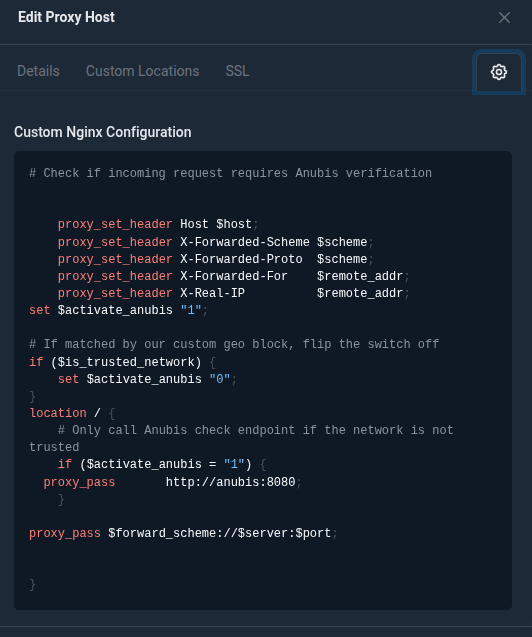
DIFFICULTY: "5"A custom location sends the domain to Anubis and retains the headers required for routing and traceability.
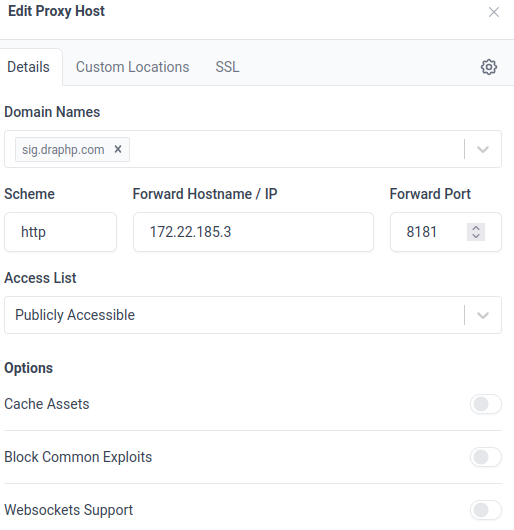
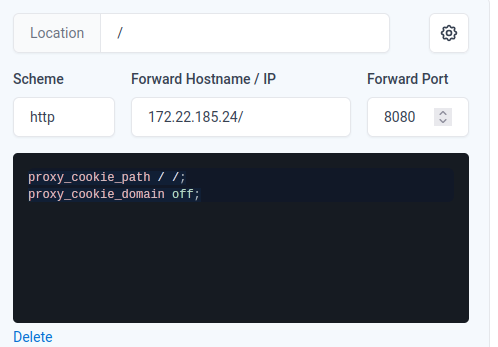
Challenge cookies and extensive user agents may require larger Nginx buffers. The validated configuration added these directives to the Proxy Manager HTTP context.
client_header_buffer_size 16k;
large_client_header_buffers 4 32k;Anubis applies the first matching YAML rule. This makes ordering part of the policy and allows interoperability routes to be evaluated before generic browser traffic.
bots:
  - name: oai-server
    action: ALLOW
  - name: block-ai-scrapers
    action: DENY
  - name: generic-browser
action: CHALLENGEDepending on the portal, APIs, sitemaps and static resources can also be kept outside the challenge. The final matrix should be tested and documented for each service.
/api · /sitemap.xml · /themes · /css · /js · /imagesInstitutional networks, recognised indexers and internal monitors can be identified with Nginx geo rules and routed directly to the final service.
A controlled request declaring GPTBot produced an explicit deny. The log identifies the host, path, agent and rule, distinguishing a policy decision from a backend failure.
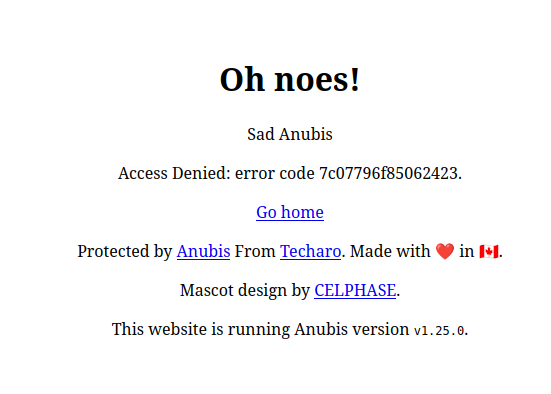
curl -A "GPTBot" https://lareferencia.info

"msg": "explicit deny"
"rule": "DENY"
"name": "bot/block-ai-scrapers"The challenge assets were rebuilt with LA Referencia branding and validated for the implementation environment.

Evidence and scope
This page synthesises the implementation validated by LA Referencia between May and July 2026. The operational evidence combines controlled requests, structured logs and one observed hour on an Internet-facing VuFind instance. Traffic patterns can change; the figures remain tied to the stated observation window.
Code and documentation
The demonstration connects the public explanation with the source projects, the LA Referencia multihost development and the complete technical record.
Derived repository containing the extension developed for multiple domains and backends.
Open code ↗ UPSTREAMAnubisOpen-source project used for bot classification, explicit rejection and computational challenges.
Open project ↗ UPSTREAMNginx Proxy ManagerEntry point for HTTPS, certificates, domains, trusted networks and routing.
Open project ↗ REPORTComplete technical reportArchitecture, configuration, validation, evidence, scope and technical continuity.
Read report ↗Project context
Work developed by the LA Referencia team within the project “Expanding and innovating federated open science infrastructure in Latin America”, supported by Invest in Open Infrastructure.
Explore the project and its progress ↗